Press Release · Ayre Think Tank
Global Study: Canada Ranks Fifth Among 56 Commonwealth Countries for Youth AI Readiness, Yet Research from Ayre Think Tank Points to Gaps in Practical AI Use
Distributed by Green Web Art · Originally issued via PR Newswire
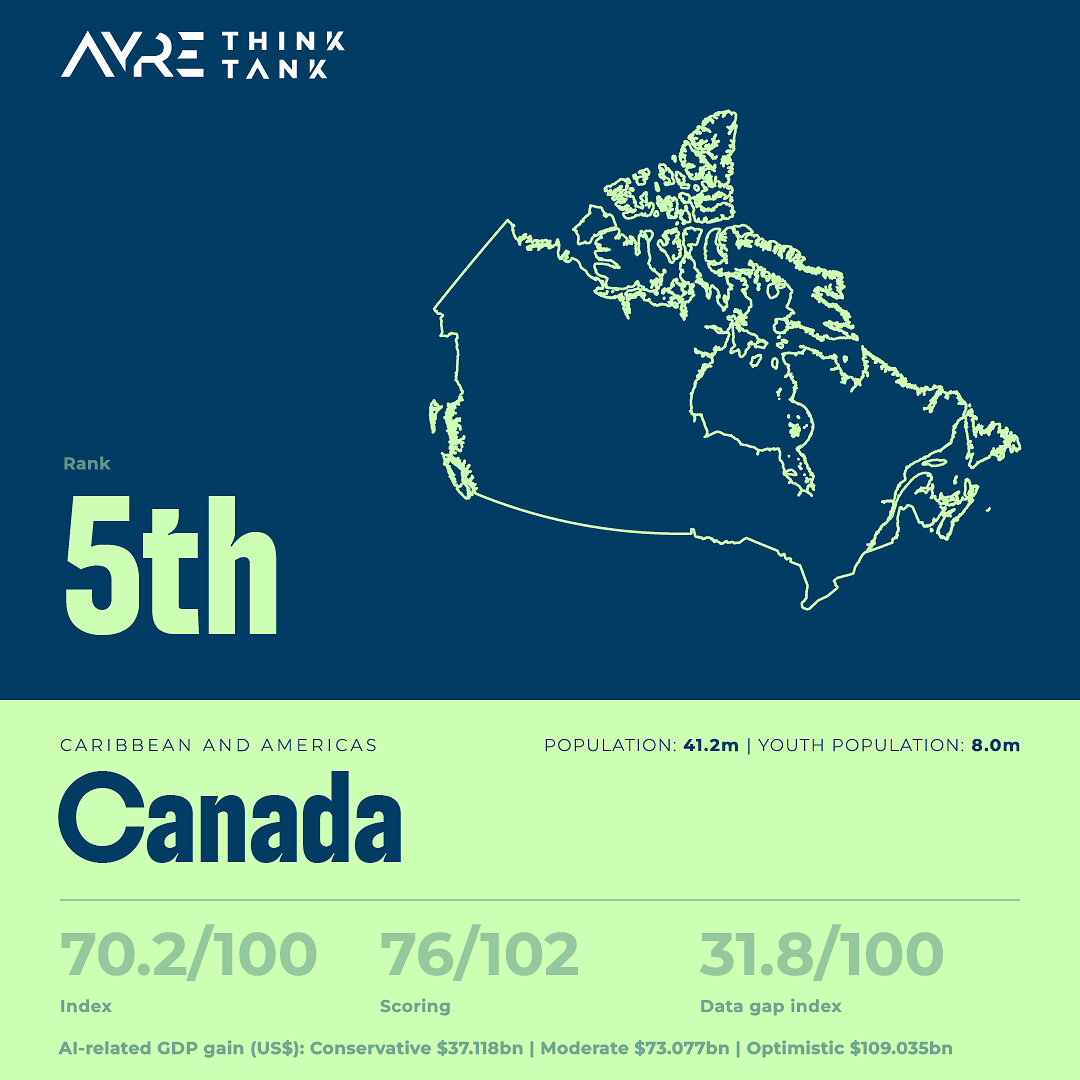
Ayre Think Tank identifies potential C$100.85-billion AI-related GDP boost over the next decade though lower-scoring education and training provision could affect economic gains
ST JOHN'S, Antigua and Barbuda, Nov. 5, 2026 — Canada's strong connectivity and digital capabilities have placed it among the Commonwealth's leaders in youth AI readiness, but education and training provision emerges as a relative weakness, according to a comprehensive new international study by the Ayre Think Tank.
The inaugural Ayre Index ranked Canada fifth among 56 Commonwealth countries, behind Singapore, Malta, Australia and the United Kingdom, with an overall score of 70.2 out of 100. Canada scored 9.4 out of 10 for both meaningful access and digital, data, media and AI capability, compared with 5.3 for education and training delivery.
The findings were just released during the Commonwealth Heads of Government Meeting (CHOGM) in Antigua and Barbuda, attended by His Majesty King Charles III and Prime Minister Mark Carney.
Speaking about the Index, Calvin Ayre, Antiguan-Canadian philanthropist, entrepreneur and founder of the Ayre Think Tank, said: "I've spent my life in businesses where new technology changes everything, and I know you can't stand still. AI is going to change how we work, how we do business and how wealth is created. What matters is giving young people the skills and the chance to get ahead – whether to start businesses, find jobs or build something for themselves."
Ayre stressed that nobody can afford to be complacent right now. "Some Commonwealth countries are ahead, others have catching up to do. Nobody can afford to be complacent. That's why we created this Index. It shows countries where they stand, what they're getting right and where they need to do better. Governments now have to decide what they're going to do about it."
One key question facing Canada now is how it can convert its strong infrastructure and youth interest into practical capability-building among youth. The potential economic stakes are significant. Researchers applied International Monetary Fund (IMF) scenarios to Canada's economy and calculated that it could gain a potential AI-related GDP increase of C$100.85 billion over the next ten years under a moderate scenario. A conservative estimate is C$51.19 billion, and the optimistic case is C$150.44 billion.
"AI readiness is the minimum standard for future success. Canada needs to ensure its education systems equip young people to move beyond readiness and become AI fluent. While youth may be regular users of AI tools, the real priority is ensuring they know how to use AI effectively, question its outputs and harness its potential to build career skills and create opportunities," said Lisa Taylor, global authority on workforce systems and founder and CEO, Challenge Factory.
Developing AI fluency requires opportunities for informed, purposeful practice, yet, according to the Ayre Think Tank's analysis of OECD PISA 2025 data, only 37.7 per cent of Canadian 15-year-olds reported using AI chatbots for schoolwork at least weekly, compared with an OECD average of approximately 46 per cent. Separately, Statistics Canada's research found that just 10 per cent of employed 15- to 24-year-olds used generative AI at work over a 12-month period.
Moreover, the Index did not identify an explicit reference to AI in the teacher-policy evidence it used for Canada, drawing on UNESCO's country profile on technology in education. Together, these findings underscore the importance of strengthening AI education and practical skills development to better prepare young Canadians for an increasingly AI-driven workforce.
The Ayre Think Tank produced a white paper reporting on the findings from the Index, and the paper identifies five global priorities: affordable and reliable access to technology; education that develops practical skills; stronger routes from training into employment and enterprise; AI tools suited to local languages and needs; and safeguards that enable young people to question automated decisions.
It calls on governments, educators and development partners around the world to better understand the barriers young people face in each country before deciding where investment can make the greatest impact.
"We need to make sure that the next generation will be able to do more than just consume AI products made elsewhere; access must come with its own agency and a real equitable stake in how these systems are governed," said C. Justin Robinson, pro vice-chancellor and campus principal of the University of the West Indies, Five Islands Campus, who contributed to the white paper's foreword.
"Young people should be equipped to question new AI tools, to improve them and to be supported in building alternatives suited to their own needs – whether that happens, however, will depend on choices made now."
More about the Ayre Index and the Ayre Think Tank can be found at https://calvinayre.com/for-progress-think-tank.
SOURCE Ayre Think Tank